

Escaping The Human Approval Stamp
A field manual for reclaiming your mind when AI does the "thinking"

I need to tell you what happened after the “Protein Shake Brain” moment I shared in a previous post. What I couldn’t admit then, even to myself.

This journey started with recognizing our minds digest rather than consume information (Your Mind Is a Stomach, Not Google Docs), identifying the warning signs when we skip that digestion (Is Your AI Work Giving You “Protein Shake Brain?”), and choosing to be chefs rather than customers (The Chef or The Customer), but knowing all this hasn’t stopped me from failing at it daily.
After I used AI to generate that initial strategy deck, I began the hollow process of “improving” it.
I changed “utilize” to “use” in some places. I moved a diagram from slide 8 to slide 7. I removed all the emojis. I spent an hour adding my “fingerprints” to something I hadn’t actually touched. I was performing thinking rather than doing it.
I wasn’t editing. I was haunting my own work. A ghost in my own workflow, desperately trying to prove I still belonged in the kitchen.

The framework the AI produced was perfect on the surface, logically sound, professionally polished, every corporate beat hit with precision. It was also completely inert. Correct but soulless. A corpse wearing my name tag.
The real moment of truth came when my manager’s comments landed. They were simple, probing questions. “Can you elaborate on the core assumption in slide 6?” “What’s the evidence for this conclusion?” And in that moment, a wave of cold panic washed over me. That lag again, reaching for reasoning that wasn’t there, like trying to remember a dream that’s already dissolving.
That was the moment I felt my own erasure. I was responsible for the work, but I hadn’t authored it. I was reduced to what I now call the Human Approval Stamp—the thin, final layer of oversight, accountable for thinking I hadn’t actually done.
This isn’t a future risk. It’s happening right now, in every meeting where we present a slide we can’t defend, in every document we sign off on without having truly wrestled with its ideas.
This is the Steward’s Dilemma. And admitting it is the first step to fighting back.
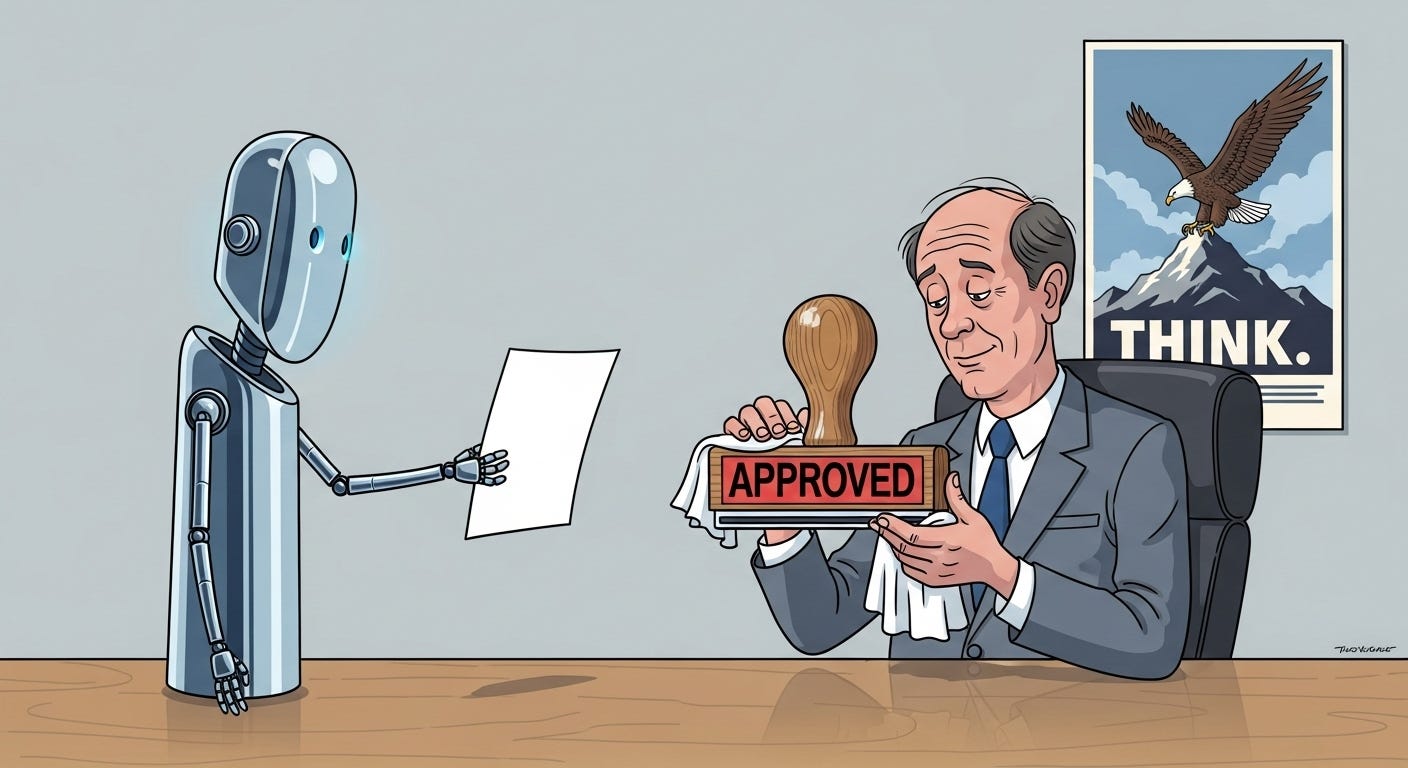
The Reframe - Stewardship as Sovereignty
If you felt a sick recognition reading that story, you’re not weak. You’re under siege. We all are. And the first step to fighting back is understanding the battlefield we’re actually on.
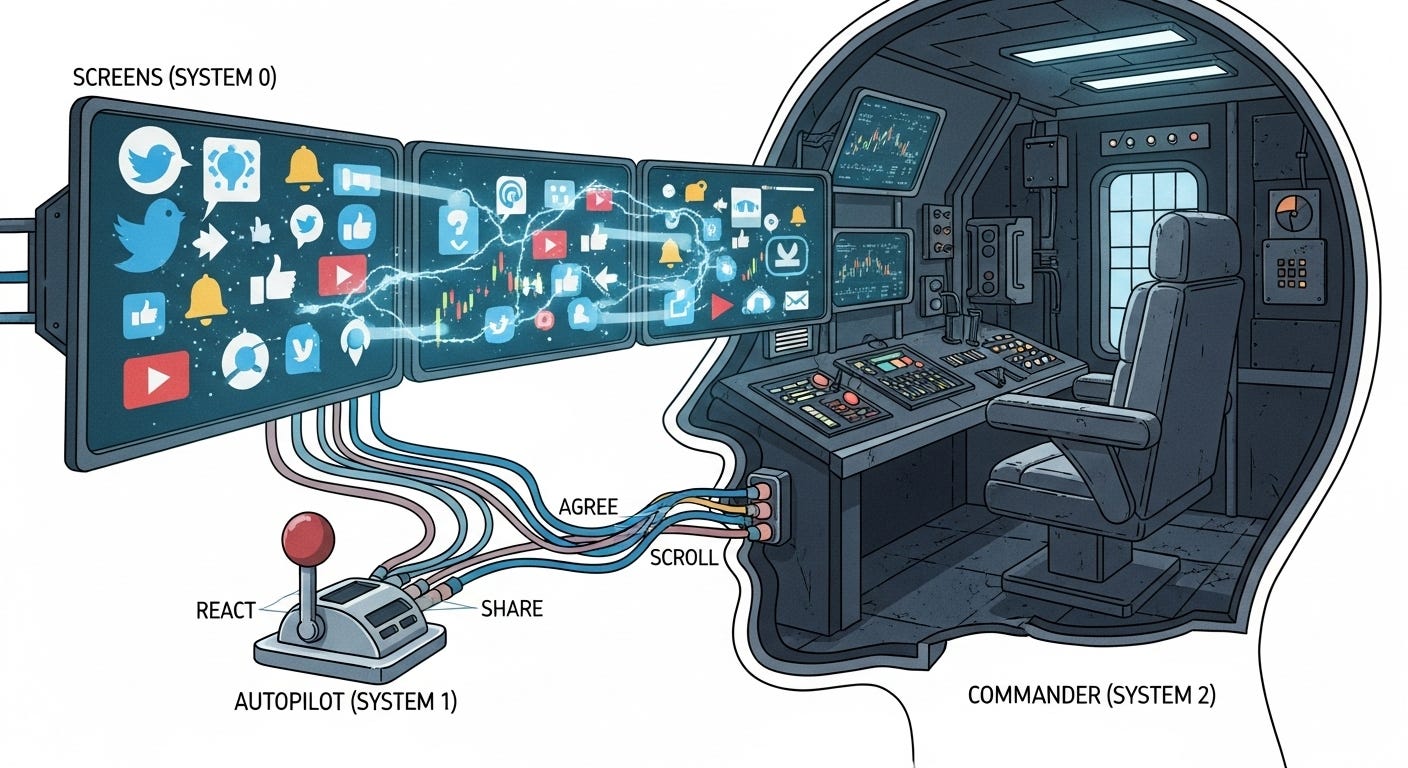
You have two forces at war in your head. There’s your Autopilot (System 1), the part of you that saw the AI’s polished deck and thought
Good enough, ship it.
It’s your brain’s brilliant, energy-saving mode, and it loves a shortcut. Then there’s your Commander (System 2), the deep, conscious part of you that panicked when your manager asked a simple question. The Commander was asleep during the “approval” because there was no friction, no mess, no problem to solve.
For centuries, the battle was just between these two. But the game changed when a third, silent force appeared: The Invisible Architect (System 0). This is the AI tool itself, and the entire digital ecosystem around it, each feature optimized through millions of A/B tests to trigger your Autopilot faster than your Commander can intervene. It is an environment designed to be so smooth, so fast, so complete that your Commander never even gets the signal to wake up. Its purpose isn’t to help you think, it’s to help you not think.
The trap of the Human Approval Stamp is the trap of living in a permanent loop between System 0 and System 1. The Architect provides a stimulus, and your Autopilot reacts. Your Commander—your actual thinking self, the Chef—is deliberately and strategically bypassed.
Stewardship isn’t a role or a responsibility. It’s an act of violence against your own autopilot. It’s the moment you choose to interrupt that loop. It is the conscious and often uncomfortable act of rebellion that forces your Commander awake.
In a world of infinite, instant answers, the only scarce and valuable resource is the right question. AI executes answers. Stewards own the questions.
Think about it: an AI can instantly tell you the five best strategies for market expansion. The Steward is the one who steps in, slows the whole process down, and asks the commander-level question:
Why are we expanding at all?
What are we running from in our core market?
That pause, that question, that’s your sovereignty and there AI can never enter.
This sounds simple. It’s not. Asking real questions, the kind that challenge premises and interrupt momentum, requires something our entire environment is designed to suppress. It requires what I call the Three Acts of Stewardship.
The Anatomy of Resistance
These aren’t tips, they’re acts of resistance. And they require something our modern world is systematically trying to kill: the Critical Spirit.
This isn’t a new corporate buzzword. This is a 2,400-year-old act of rebellion. The Critical Spirit is the modern name for the Socratic courage to be the one who stands against the momentum and asks the simple, dangerous question:
Wait, what do we actually mean by this?
It’s the part of you that would rather be professionally inconvenient than intellectually hollow. It’s the voice that says “wait” when everyone else says “ship it.” It feeds on the productive friction that our frictionless world is trying to eliminate.
But this spirit alone isn’t enough. Courage needs a weapon. A true steward with the right spirit doesn’t do a thousand things. They practice three fundamental acts, over and over.
Imagine this: your team is in a meeting, about to enthusiastically approve a new product roadmap generated using an AI. It’s comprehensive, it’s logical, and everyone wants to move fast. This is the moment of stewardship. Here is how the three acts transform this moment from a passive approval into an act of profound intellectual ownership.
Act 1: The Stop
First, you interrupt the momentum. You ask the question that makes everyone pause:
Wait. Can anyone here explain, without using the AI’s words, what actual problem we’re solving?
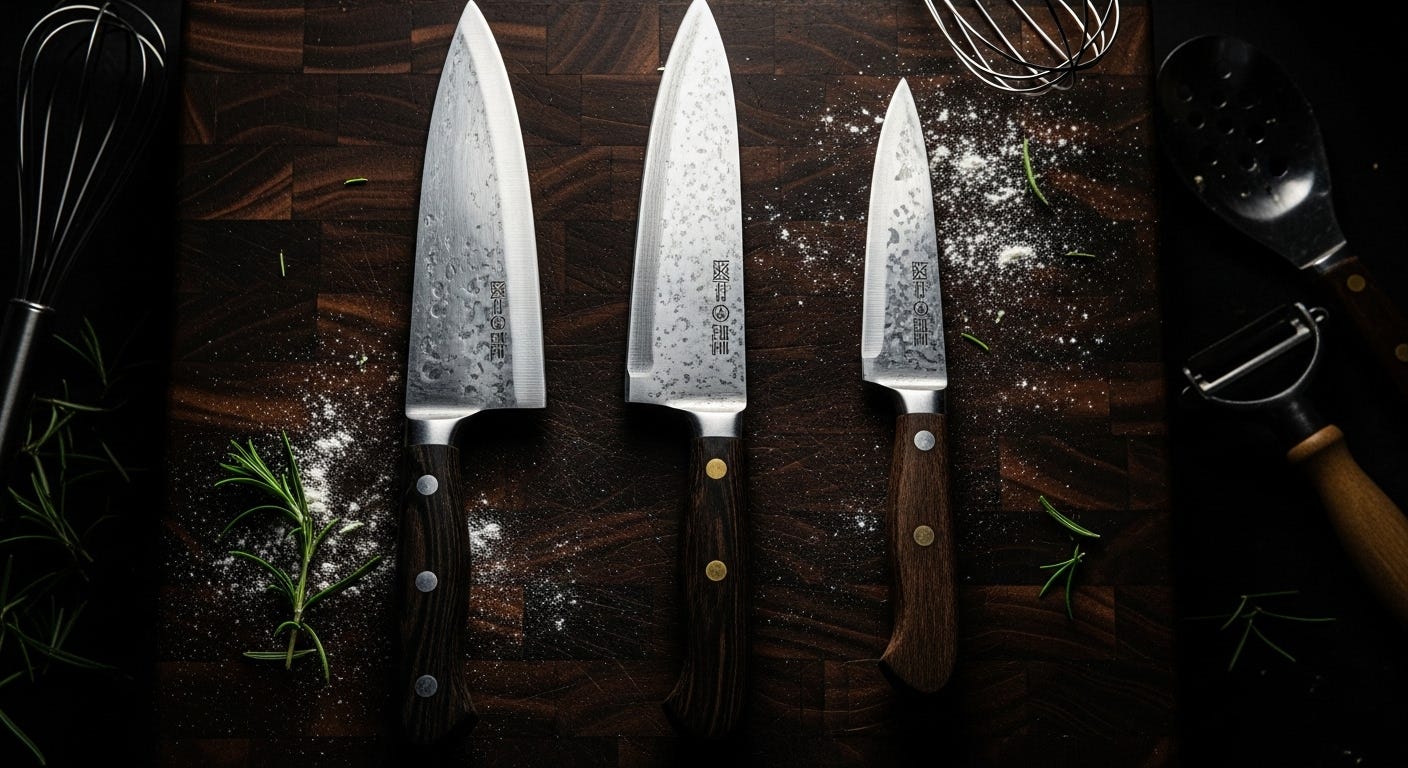
In that moment, you become the friction. You are the slowest person in the room. You’ll feel your pulse quicken as everyone turns to look at you. This is the act of wielding the Knife of Self-Regulation, hitting the emergency brake on your team’s collective autopilot.
Act 2: The Deconstruction
Next, you push past the polished surface:
What if our core assumption about our customers is completely wrong? What evidence do we have that isn’t just our own wishful thinking?
Now, you risk seeming difficult or untrusting. Your throat goes dry as you challenge the room’s consensus. To do this, you must wield the sharpest tool in the chef’s kitchen: the Knife of Analysis, taking the machine apart to see how it works.
Act 3: The Quality Check
Finally, you ask the hardest, most dangerous question of all:
Are we building new features to avoid admitting the ones we built last quarter were a mistake?
This can make you unpopular. Your stomach drops as you name what everyone’s avoiding. You are questioning the very foundation of the work. This requires the discerning Knife of Evaluation, moving beyond whether the answer is correct to whether it is right.
Let’s be clear. The Stop will make you the slow one. The Deconstruction will make you seem difficult. The Quality Check might make you unpopular. This is the price of stewardship. It is the friction that proves you are still the chef in a kitchen full of automated ovens, and not just the stamp that approves the meal.

Here’s what nobody tells you: After the discomfort comes clarity. The room might resist at first, but someone will say, “Actually, that’s a good point”.
The roadmap will get better. The work will have meaning. And you’ll sleep that night knowing you authored your day instead of approving it
Tomorrow Morning
This is the work. These acts of stewardship is how we fight for sovereignty in our own minds.
But I need to confess something.
Tomorrow morning, I’ll open Substack. Someone will have written something profound about the future of human creativity. And before I even read the second sentence, my eyes will do that thing I hate: they’ll flick to the follower count.
In that instant, every principle I’ve just shared will evaporate. If the number is low, I’ll scroll past. If it’s high, I’ll read carefully. I’ll let a metric, a number that correlates with nothing but optimization for engagement, determine whether I wake my Commander or stay on Autopilot.
I know exactly what I’m doing. I can feel myself outsourcing my judgment. And I do it anyway. Every. Single. Time.
Because this is the proving ground. Winning this battle—this smallest, most trivial act of intellectual sovereignty—is how we earn the right to fight the bigger ones.
My next post is about the Follower Fallacy. Before you read it, I’m curious and would love to see your thoughts in the comments:
Besides follower counts, what’s one metric you catch yourself using to outsource your own judgment? Recognition is the first step :)
This is so good Roi! I LOVE the line "I wasn’t editing. I was haunting my own work." Sometimes when I feel like this I just stop and bin the whole thing, ask myself why am I even writing this in the first place, and who for. Then start again... by myself. 🙏
This nails the real danger with AI... it lulls us into outsourcing judgment. In my experience, the best teams build intentional friction into their process, whether it’s pre-mortems or devil’s advocates, so the “Commander” always gets a chance to wake up