

Owned, and Still Half-Seen
We can do all the thinking, own the work to its root, and still miss the one thing only someone else can see.

It was day nineteen, and my stomach tightened before I knew why.
I was looking at a table on a screen. It showed every engineering team’s operational health, service by service. The data was right. The layout was clean. A VP could open it and see exactly where the organization stood. That was what bothered me, though I couldn’t have said so yet.
I typed the discomfort into the conversation, roughly:
this still lets a VP look at the table and ask a team lead why they’re failing, and we are not building surveillance.
Once it was written down I could see the whole shape of it. The table was breaking a rule I’d set in the first week: no ranking, sort by name only, so no one could line the teams up and ask the ones at the bottom to explain themselves. And there it was, sorting teams best to worst, readiness in fractions, two of four, ten of twelve, amber when something was off. Anyone could screenshot it and drop it in a channel: Explain yourself. Nothing in the table was wrong. All of it was a scoreboard.
We rebuilt it that afternoon. New heading. No ranking. Health in place of scores. A next step on every row.

I never wrote that table. I never read the code behind it, or behind any of it. I spent twenty-one days building the whole platform and did not read or write a single line. What I did was decide what it was allowed to be, and hold everything the machine produced against that. The tightening in my stomach was mine. The judgment was mine. The code was another set of hands carrying out what my judgment had already settled.
That is one way it can go. Earlier the same year it went the other way. I made a strategy deck, made it well, and sent it with pride, and when a few gentle questions came back two mornings later I reached for the reasoning under my own sentences and my hand closed on nothing, the way it does groping for a light switch that isn’t where it always is. It looked like mine. It had not lived like mine the moment anyone pressed.
So: a thing I never touched, and owned completely. A thing I made with my own hands, and didn’t. Making and owning, which are supposed to be one act, come apart in both directions, in the same person, months apart.
For as long as the work was ours to make, making it and thinking it through were the same motion. We could not reach the end of the report, the design, the code without walking every fork it held. So the finished thing stood as proof of the thinking, because for work we made ourselves there was no other way to arrive at it.
That is what changed. The tool can walk the forks now and hand us what is on the far side. We can hold a finished thing we never thought our way through.
That is the deck. I put it together, but the thinking never passed through me, and what came out was whole and clean and not mine. And Ground Control is the same fact from the other side. I never touched the making, and it was mine to the root, because the thinking had passed through me first. I had been building the principle I held that table against for twenty years, and it had gone through me so completely that it reached me as a feeling before it reached me as a sentence.

Both times, the same thing decided it: whether the thinking had passed through me first. That is what we own, the thinking that went through us. The mark of it is whether the reasoning is still there when we reach back for it.
The reviews we have always trusted never asked whether the thinking happened, because the finished work was always proof enough that it had.
We own the layers we went through. The rest we wave past. The line between them sits lower every year as the tools improve, and we draw it now without noticing we have drawn it at all.
We can only go through a fork we can see. The ones we never see, we never own, and we never miss.
The most useful thing I know about ownership, I learned by not being able to hand it to anyone.
Two years ago I came in as the architect on a team that had spent six years certain their trouble was the database, ready to tear it out and start again. Fairly soon it looked to me like the database was not the trouble at all. The trouble was the shape of the thing underneath it, a model nobody had ever drawn a boundary through. Say I was right. It changed nothing. I said it, and the team leads did not agree, and their manager did not agree, and I could have forced the migration through on my title and watched it get built and resented and owned by no one. So we left it open. For most of a year we turned it over together and got it wrong together, while I mostly stayed out of the way of my own conclusion. Then a team lead came in one morning and said, I had a dream, and I think you’re right. What moved him was a year of the idea working on him while I stayed back. After that they built it themselves, and it held, because by then it was theirs.
You cannot hand someone an understanding. For years the way I lived with that was to keep quiet and let people arrive on their own.

Then keeping quiet stopped being enough, because the tool hands over the answer now, free and instant, whether or not anyone wanted to think. The one move I had relied on for twenty years, not giving the answer, is the one none of us can make anymore.
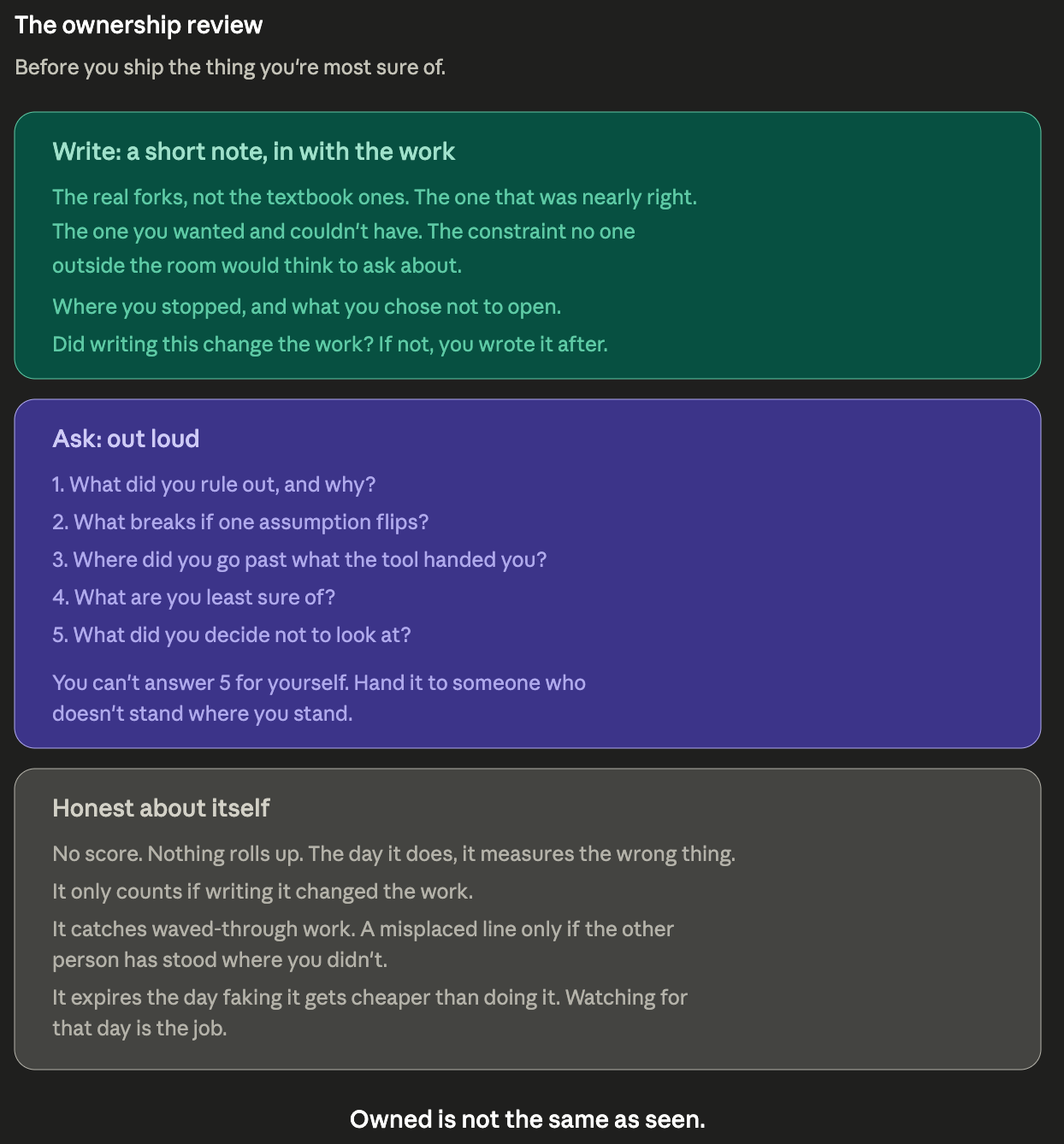
So I wrote down what my silence used to do on its own. It is a short note, meant to go in with the work, and it asks for what the finished work leaves out:
The real forks, not the textbook ones: the one that was nearly right, the one you wanted and could not have, the constraint nobody outside the room would know to ask about.
Where you stopped, and what you chose not to open.
One test on all of it: did writing it change the work? If nothing moved, it was written afterward, whatever the timestamp says.
Then a few questions, asked out loud:
What did you rule out, and why?
What breaks if an assumption flips?
Where did you go past what the tool handed you?
What are you least sure of?
And one more:
what did you decide not to look at?
None of it is unfakeable. The machine can draft the note and rehearse the answers, but making them hold past the second follow-up takes having done the thinking, which was the thing skipping was for.
And it still would not be enough. I know because I have owned a thing completely and walked straight past what mattered in it.
I wrote a paper with Moshiko, my research partner, someone I have come to deeply appreciate. We owned it all the way down. Months of it, every claim argued, every move deliberate. We built it on an idea: that we relate to these AI systems a little the way a small child relates to a worn blanket, a thing the child pours itself into until it becomes real enough to hold them. We worked that idea through every fork it had. I could have answered any question about it.
A reviewer sent back a line I had not seen coming. The systems we were describing, the reviewer wrote, are not wholly dependent on the user, and that disanalogy is never discussed in the paper. A blanket is wholly the child’s; it holds only what the child pours in. This thing is not like that. It answers. It brings its own weight, from outside anything we made. And we had never said so.
The reviewer was right, and neither of us had seen it. Moshiko and I catch each other’s blind spots for a living; between us, almost nothing gets through. This got through both of us, and not because we were careless. Because we were standing inside the idea, and we cannot see the edge of the thing we are standing inside. The reviewer was standing somewhere else, and from there the edge was the first thing to see. That break became the center of the paper, the thing it had to say.
Here is what did not happen. The reviewer did not catch us. There was nothing in the pages to catch, because we had skipped no thinking; we had done all of it. A finished thing looks the same either way. What the reviewer could see was what was missing, because they knew the shape that should have been there and we did not.
And here is the part that should stop us. Ask my own five questions of that paper, before any reviewer saw it, and I pass every one, the fifth included: what did I decide not to look at? I answer it honestly and well, because I had done the work. The one thing the questions cannot reach is the fork I could not see to name. My own note, my own review, the whole thing I built, would have handed that paper back to me clean.
That is the edge of a field. No amount of looking gets us past it, because the looking is always done from the same place we are standing.
So here is where it stops.
Most of the instrument still works, and works alone. The note is not a detector; writing down our real forks before the thing is finished is only thinking, done in time to still change it, and it holds no matter who is in the room. The four questions read whether we carried the work, and we can put them to ourselves. What none of it reaches is the fifth. We cannot get outside our own work; there is nowhere to stand that is not still us.
The machine cannot reach it either, and I know because I tried. I once set four search agents loose on everything I had ever made, the papers, the essays, every conversation from building a product without touching the code, hunting for a single time I had drawn a line and been wrong beneath it without knowing. What they handed back was my own record, read back to me. That is the trouble with a record: I made it, from where I stand, so my blind spots are folded into it, filtered out exactly where I cannot see. A tool reading only what I have written reads only from the place I was already standing. It can catch a great deal, more than I can alone. What it cannot catch is the thing I never took in from where I stood, because that was never mine to write down. So I stopped looking in the record. The one place the missing thing had ever lived was outside it, in the people who had watched me work, who saw the pause and the tone and the times I changed the subject, none of which I ever thought to keep.
So the fifth question is not one we answer. It is one we hand across. Here is where I stopped, we say, and here is the line I drew. Look under it. And we hand it to someone whose field is not shaped like ours, because only from somewhere we have never stood does our edge become the first thing anyone sees.
It will not make us safe. There is no safe. The person we hand it to has an edge of their own, and the two of us together have one wider still, and somewhere past that is a stranger who sees what neither of us can. It does not close. It was never going to close. The questions have a shelf life, too. The day faking the answers costs less than doing the work, faking is all they will find, and watching for that day is most of the job.
This is the whole of why it stays ours. If a tool could close it, we would install the tool and stop, and the thinking would be over. The gap that will not close is the reason we still need each other, the reason none of this gets handed off and finished, the reason judgment stays ours to keep.
So the next time we finish something that matters, something we are sure of, we might do the one thing we are least likely to do when we are sure of ourselves. Find the person who does not stand where we stand. Show them where we stopped. Ask them to look under the line. And then, on the next thing, do it again.
Moshiko and I wrote the paper this story is about, on why these systems can feel like a companion that isn’t one. If that feeling is familiar, it’s here: The relational–epistemic stance: generative AI as a dynamic transitional object (AI & Society, Springer)
The geometry of your fifth question stays with me. You've identified something with real formal shape: the blind spot isn't an oversight, it's structural. You can't see the edge of the field you're standing inside because the field *is* your vantage. Your four search agents failed not because they were weak but because they were reading from coordinates you'd already set, "my blind spots are folded into it, filtered out exactly where I cannot see." That's a topological claim, whether you meant it as one or not. The deformation a blind spot produces in the surrounding material is visible only from a vantage that can compare the field's actual shape to what its undeformed shape would have been, a vantage structurally unavailable to the system whose field it is. Which is why your answer, hand it across to someone standing somewhere else, isn't a workaround. It's the only move the geometry permits. The gap that won't close isn't a failure of method. It's the reason method needs company.
— Iman and Darja